The Morgenthau six principles of realism form the foundation of classical realist theory in international relations. These principles explain how power, national interest, and human nature shape global politics.
Hans J. Morgenthau introduced these ideas in his famous book Politics Among Nations (1948). He argued that international politics is governed by objective laws rooted in human nature. According to him, states always act to protect their national interest, which he defined in terms of power.The six principles outline key ideas such as interest defined as power, the dynamic nature of national interest, limits of moral principles in politics, and the autonomy of the political sphere. Together, they provide a systematic explanation of how and why states compete in world politics.
Even today, Morgenthau’s six principles remain central to the study of classical realism and continue to influence foreign policy thinking across the world.
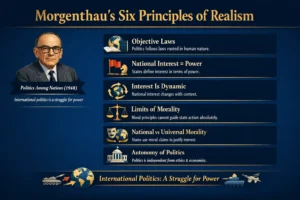
Morgenthau six principles of realism
The six principles of Morgenthau in realism provide a systematic explanation of how power and national interest shape international politics. These principles outline the core assumptions of classical realism and explain why states act in pursuit of power in an anarchic international system.
First Principle: Objective Laws
According to Morgenthau, politics is governed by objective laws that emerge from both human nature and society. To formulate a logical theory of international politics, it is important to understand these laws. In one of his well-known quotes, he stated that “moral arguments cannot challenge political actions that follow the law.” This principle underscores:
– Humans are inherently power-seeking.
– States, as extensions of human communities, also pursue power.
– Historical patterns reveal underlying motives driving state behavior.
This principle emphasizes realism’s importance in crafting theories that are intellectually rigorous and applicable to global politics.
2. Second Principle: National Interest explained as National Strength.
The second principle is the core of Morgenthau’s realist theory. It states that states define their national interest in terms of power and act to secure that interest through power. For Morgenthau, the concept of “interest defined as power” provides the key to understanding international politics. Without power, national interest remains only an abstract idea with no real impact in world affairs.
According to this principle, foreign policy decisions are shaped by calculations of national strength. Political leaders evaluate what will protect or enhance their country’s position in the international system and design policies accordingly. Power, therefore, becomes the central category through which state actions are analysed and understood.
Morgenthau also argued that moral language and ideological claims often serve as justification rather than the true motive behind state behaviour. While leaders may speak in terms of justice, democracy, or peace, their actions are usually guided by considerations of national interest and power. In this way, realism emphasises political necessity over moral preference.
This principle establishes power as the primary determinant of foreign policy and places national interest at the centre of international relations.
3. Third Principle: Interest is always Dynamic
National interest and national power, the key determinants of a nation’s foreign policy according to Morgenthau, are dynamic. Rather, they are dynamic and constantly changing based on shifts in the political and social environment. Morgenthau believed that national interest must be continuously re-evaluated and redefined as circumstances change. What a nation perceives to be in its interest today may look very different than its interests a decade from now. As such, realist theory argues that leaders and policymakers must repeatedly analyze national interests to realistically direct the course of international relations.
Similarly, national power is not fixed, but ebbs and flows as a country’s resources, capabilities, and global standing evolve. As the balance of power shifts between nations over time, so too does the relative power and position of each state. This fluctuating power dynamic ensures that the international order is never permanently settled, but rather endures constant reshaping and reordering as nations seek power advantages.
According to Morgenthau, properly accounting for the dynamic nature of national interest and national power is essential for formulating realistic foreign policies. Only by continuously re-evaluating a nation’s place in the world can leaders make prudent decisions to advance its position through diplomacy and power politics. Morgenthau thus saw national interest and power as living concepts, requiring frequent redefinition and analysis by states seeking to navigate an ever-changing global landscape.
4. Fourth Principle: Moral Principles Don’t Apply to State Actions
A core tenet of political realism is that moral principles cannot be applied to the actions of states on the international stage. According to realists, states cannot and should not be held accountable to a universal set of ethics or values. The reason is that a nation’s foreign policy and national interests are not formulated based on adherence to moral principles. Instead, realism asserts that a state’s policies and conduct in the international sphere are determined primarily by the pursuit of national power and self-interest.
Realists contend that it would be naive to expect governments to abide by the same moral standards and principles that individual human beings are reasonably expected to follow. The international arena is viewed as an amoral realm, an anarchic self-help system where morality does not factor into state calculations and behavior in the way it governs individual conduct and choices.
States may sometimes invoke moral arguments to justify their actions propaganda, but realists maintain that this is merely rhetoric intended to portray the nation favorably, not the actual motivations which are grounded in rational calculations of national interest and power.
The desire to preserve and increase national power, not adherence to ethical values, is seen as the force that shapes decision-making. According to realist theory, while moral principles may influence the behavior of states to some limited degree, they will never override or supersede considerations of national interest and power. States are expected to pursue policies that strengthen their geopolitical position rather than conform to an external moral code. Realism asserts the autonomy of the political sphere from the moral sphere when it comes to the conduct of states in the international arena.
5. Fifth Principle: Difference between the Moral Aspirations of a Nation and the Universal Moral Principles
Morgenthau did not see ethics playing a significant role in international politics. According to him, national interests and policies of any nation cannot be based on universal moral principles. Instead, Morgenthau believed that each nation tries to hide its true national interests behind the mask of moral principles.
In his view, a nation’s actions are always ultimately based on national interests and the pursuit of power, not adherence to universal moral principles. Morgenthau argued that while nations may claim their policies are founded on moral principles, this is merely rhetoric used to obscure motives grounded in the national interest.
Nations invoke moral principles as propaganda to portray their actions favorably when in reality they aim to increase relative power. Nations pretend to adhere to moral codes but in fact, make strategic calculations of national interest. Universal ethics are proclaimed to mask ulterior motives of maximizing power.
6. Sixth Principle: Autonomy of the Political Sphere
Like economists, lawyers, and those who talk about what’s right or wrong, realism wants to study the fight for power among countries. Every country tries to keep or gain more power. Realism believes that the political sphere operates autonomously from other spheres like economic, legal, and moral. While economic, legal, and moral factors are considered, realism gives priority to political aspects in studying relations between states. The realist view is that the fundamentals of international politics are shaped by the struggle for power and national interest, not by economics, law, or morality.
These other spheres do influence state behavior, but realism asserts the autonomy of the political sphere as the determining factor in international relations. Politics and the dynamics between nation-states take primacy over other areas of international relations according to realism. The quest for power, rather than economic or legal considerations, is seen as the key driver of how countries interact and relate to one another on the global stage. Moral factors may come into play, but realism contends that these ultimately have little influence compared to political calculations based on national interest.
In sum, realists believe that international relations are fundamentally shaped by power politics between states seeking to advance their interests, not by ethical standards, economic interdependence, or legal obligations. This principle of the autonomy of the political sphere places power dynamics between nation-states at the center of understanding world affairs.
Significance of Morgenthau’s 6 Principles of Realism
Morgenthau’s six principles of realism provide an important theoretical lens for understanding international relations. By outlining key tenets around objective laws, national interest and power, and the autonomy of the political sphere, the principles offer guidance for statecraft. At the core, the principles emphasize the primacy of national interest and power in driving foreign policy. According to Morgenthau, nations must define and pursue their interests in terms of national power.
This view stands in contrast to those that give greater weight to ideological or moral factors. The principles argue that moral principles cannot be directly applied to the actions of states on the international stage. By grounding analysis in national interest and power, the principles aim to build a rational and realistic theory of international politics. Rather than ethics, Morgenthau stresses political prudence as a guide. The principles provide an influential perspective that still shapes realist thought today. Their focus on harsh realities over idealism continues to inform the worldview of many foreign policy experts and decision-makers.
Criticisms of six principles of morgenthau
The six principles of realism of Morgenthau have been criticised by many scholars for being overly state-centric and heavily focused on power politics. Critics argue that the six principles of Morgenthau give limited space to cooperation, international institutions, and non-state actors in global affairs.
Morgenthau’s principles of realism have been criticised on several grounds:
Too Pessimistic About Human Nature
Many, especially liberals, argue that Morgenthau paints an overly pessimistic view of human nature as simply power-seeking. They contend that human nature also encompasses cooperative and altruistic tendencies. Morgenthau’s description of human nature as solely animus dominandi (struggle for power) is seen as incomplete and biased.
Power Monism
Stanley Hoffman argued that Morgenthau’s principles suffer from “power monism” – overemphasizing power as the key factor in international relations at the expense of other factors. Critics contend that many other factors like ideology, culture, norms, etc. also significantly influence state behavior and foreign policy.
State-Centric
The rise of non-state actors and increasing international cooperation has made Morgenthau’s state-centric view of world politics seem limited. Transnational corporations, NGOs, and regional and global institutions play important roles today. Focusing only on states as the key actors is seen as outdated.
Conclusion
The Morgenthau six principles of realism remain one of the most influential foundations of classical realist theory in international relations. Through these principles, Morgenthau explained that politics is governed by objective laws rooted in human nature, and that states define and pursue their national interest in terms of power. He also emphasised that national interest is dynamic, moral principles cannot be applied universally to state actions, and the political sphere operates independently from economics, law, and ethics.
Together, the six principles of Morgenthau in realism present international politics as a continuous struggle for power among nation-states. Rather than relying on moral ideals, Morgenthau argued that foreign policy must be guided by prudence, national interest, and an understanding of power realities. This approach offers a systematic framework for analysing global conflicts, diplomacy, and state behaviour.
Although critics argue that Morgenthau places too much emphasis on power, his theory continues to shape realist scholarship and foreign policy analysis. Even in contemporary international politics, the six principles of realism of Morgenthau provide a practical lens for understanding how states act in an uncertain and competitive world order.
FAQ on Hans Morgenthau and Realism
What is realism according to Morgenthau
Hans Morgenthau says realism is a view that sees politics as a struggle for power. He believes this struggle follows objective laws that come from human nature. For him, national interest is always defined in terms of power. This is the central idea of his theory. His six principles of political realism explain that states act to protect their self interest. They try to gain, keep, or increase power. He also says universal moral rules cannot guide every action. Leaders must adapt moral ideas to each political situation.
What were Morgenthau’s main arguments
Hans Morgenthau argues that international politics is a struggle for power. He says this struggle follows objective laws that come from human nature. States always place their national interest first. He defines this interest in terms of power. He also says foreign policy must follow prudence and a realistic view of the world. Moral ideas cannot guide action unless they fit the real situation.
Key arguments
- International politics is a struggle for power.
- Politics is governed by objective laws rooted in human nature.
- National interest is defined in terms of power.
- Power is the central goal of state action.
- Moral principles cannot fully guide foreign policy.
- Prudence is the key guide in political decisions.
- Diplomacy requires balance and compromise.
- Politics is an autonomous sphere, separate from ethics and economics.
Who is the father of realism theory
Hans Morgenthau is widely known as the father of modern realism in international relations. His book Politics Among Nations explains the core ideas of classical realism in a clear and systematic way. Earlier thinkers like Thucydides and Machiavelli gave early forms of realist thought. However, Morgenthau turned realism into a major school in the 20th century. He defined it through the idea of national interest, understood in terms of power.
What is the main work of Hans J. Morgenthau
The most famous work of Hans J. Morgenthau is Politics Among Nations, first published in 1948. It explains his realist theory. It introduces the idea that international politics is a struggle for power. It also sets out the main principles of the realist approach that students still study today.
5. What are the main principles of realist theory (based on Morgenthau)
Morgenthau gives six main principles of realism.
- Politics is guided by objective laws that come from human nature.
- Interest is defined in terms of power.
- Power shapes all political actions.
- Moral values cannot replace national interest.
- States act with reason and awareness of limits.
- International politics is different from personal morality.
These principles explain why states act with caution and focus on power and interest.