Socrates, Plato, and Aristotle are the three names on which Western political thought really rests. None of them worked alone. Socrates taught Plato. Plato taught Aristotle. Aristotle went on to tutor Alexander the Great. In this one unbroken chain of teacher and student lies the birth of Western philosophy, ethics, and political science as we know them today.
Why compare these three thinkers at all? Because political philosophy in the West doesn’t begin with three separate voices. It begins with a conversation. Socrates asked the hard questions. Plato took those questions and built an ideal, imagined world around them. Aristotle brought that world back down to earth and turned it into something closer to a science. To understand any one of them properly, a student of UGC NET, UPSC, or MA Political Science needs to see how the other two shaped him, agreed with him, and, quite often, pushed back against him.
This article brings all of that together in one place. Who was each philosopher? What did he believe? Where did the three agree, and where did they break away from each other? And what did each one leave behind for the political thought that followed?
Socrates, Plato, and Aristotle in Chronological Order
Timeline of birth and death
| Philosopher | Born | Died | Historical period |
|---|---|---|---|
| Socrates | 469 BC | 399 BC | Golden Age of Athens, Peloponnesian War |
| Plato | 428/427 BC | 348/347 BC | Post-Peloponnesian War Athens |
| Aristotle | 384 BC | 322 BC | Rise of Macedon under Philip and Alexander |
Teacher-student lineage
Socrates (469–399 BCE)
      │
      ▼
Plato (427–347 BCE)
      │
      ▼
Aristotle (384–322 BCE)

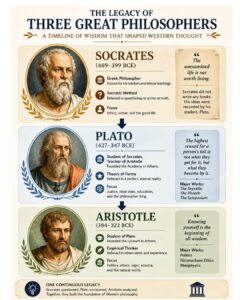
Socrates never wrote down a single word of his own philosophy. Everything we know of him comes through his students, mainly Plato, and to a smaller extent Xenophon. Plato was shaken by his master’s execution in 399 BC and left Athens for years of travel before he finally returned to found the Academy in 388 BC, often called the first European university. Aristotle joined this Academy at just seventeen and stayed there for nearly twenty years, right up to Plato’s death, before eventually founding his own school, the Lyceum.
Relationship Between Socrates, Plato, and Aristotle
Socrates as Plato’s mentor
Plato was an aristocrat by birth, with every door to Athenian politics open to him. He turned away from public life after watching two governments in a row misuse their power: first the oligarchic Rule of Thirty, then the restored democracy, which went so far as to execute his own teacher on charges of corrupting the youth and impiety. That single event convinced Plato that politics, as it was actually practised, was rotten at the core. No city would ever see real justice, he came to believe, until philosophers became rulers or rulers became philosophers. Socrates remains the main speaker in nearly all of Plato’s dialogues, and scholars still argue over how much of that “Socrates” is the real man and how much is Plato’s own thinking placed in his teacher’s mouth.
Plato as Aristotle’s teacher
Aristotle travelled to Athens from Stagira and studied at Plato’s Academy for close to two decades. He absorbed Plato’s theory of Forms and his moral seriousness, but slowly drifted away from his teacher’s idealism. People have often compared their relationship to that of J.S. Mill and Bentham: a student who respected his teacher deeply yet rejected large parts of what he taught. Aristotle’s own line, that he loved Plato but loved truth more, sums up that tension well.
Evolution of Ancient Greek political thought
Read together, the three philosophers trace a single arc. Socrates asks what virtue and justice really are. Plato answers with a blueprint for an ideal state, grounded in eternal Forms. Aristotle rejects that blueprint and replaces it with a practical science built from the study of real Greek city-states. Political thought in the West, then, moves from a question, to an ideal, and finally to a science.
Quick Comparison Table
| Feature | Socrates | Plato | Aristotle |
|---|---|---|---|
| Born | 469 BC, Athens | 428/427 BC, Athens | 384 BC, Stagira |
| Teacher | None (questioned the Sophists) | Socrates | Plato |
| Student | Plato, Xenophon | Aristotle | Alexander the Great |
| Major works | None written; known through Plato’s dialogues | The Republic, The Statesman, The Laws | Politics, Nicomachean Ethics, Constitution of Athens |
| School founded | None | The Academy | The Lyceum |
| Main focus | Ethics, self-knowledge, the meaning of virtue | The ideal state, theory of Forms, justice | The best possible state, classification of governments |
| Famous idea | “Know thyself”; virtue is knowledge | The philosopher-king; theory of Forms | Man is a political animal; rule of law |
Who Was Socrates?
Early life
Socrates was born in Athens in 469 BC, the son of a sculptor and a midwife, and he spent the whole second half of the fifth century BC living in that city. He never fought a war of ambition and never held office. His real battlefield was conversation. He liked to say that his method of questioning was a kind of midwifery, like his mother’s trade, helping people give birth to ideas that were already sitting, half-formed, in their own minds.
Political thought
Socrates left behind no systematic political theory of the kind Plato or Aristotle wrote. His importance to politics lies somewhere else: in his insistence that no law, custom, or tradition deserves acceptance simply because it is old or widely believed. Personal investigation and reasoned argument, he held, are the only proper way to answer questions about justice, the laws of the state, and the nature of religious faith.
Ethical philosophy
At the centre of Socratic ethics sits one bold claim: virtue is knowledge. If a person truly knows what is good, Socrates argued, that person will act on it, because no one does wrong on purpose. Wrongdoing, in his view, is always a failure of understanding, never a deliberate choice of evil. And since virtue is a kind of knowledge grounded in reason, and reason works the same way in everyone, moral and political laws must hold true universally, not merely by convention, as the Sophists claimed.
Socratic Method
Socrates called his style of questioning the elenchus, Greek for “putting to the test.” He would question anyone who claimed to be wise, drawing their views on justice or virtue out into the open until the contradictions in their thinking became obvious, proving that they did not really know what they thought they knew. The method works dialectically. It starts with a widely accepted statement, or hypothesis. That hypothesis is then tested against an opposing view, contradictions come to light, and the hypothesis gets rejected or refined. The process repeats, moving the conversation toward fewer and fewer contradictions, rather than toward one final, settled answer.
Major contributions
- Establishing that ethics must rest on reasoned enquiry, not inherited authority
- The elenchus, a method of dialogue still used in legal and philosophical training today
- Insisting on the universality of moral knowledge against the relativism of the Sophists
- Laying the philosophical groundwork on which Plato, and through him Aristotle, would build
Major works
Socrates wrote nothing at all. Everything attributed to him comes through Plato’s dialogues (Apology, Crito, Phaedo, Republic, Meno, Gorgias, among others), and separately through Xenophon’s writings.
Legacy
Socrates was tried on three charges: denying the national gods, introducing new gods, and corrupting the youth. He was condemned to death by hemlock in 399 BC. His execution shaped Plato’s entire outlook on politics and stands as one of the founding moments of Western philosophy. He is still remembered as the father of Western ethics and of the questioning method that underlies much of philosophical education even now.
Who Was Plato?
Early life
Plato was born into an aristocratic Athenian family around 428/427 BC. As a young man he genuinely wanted a life in politics, but his disillusionment with the governments that followed the Peloponnesian War, and above all the execution of Socrates, turned him toward philosophy instead.
The Academy
After years of travel through Italy, Sicily, and Egypt following his teacher’s death, Plato came back to Athens and founded the Academy in 388 BC, often called the first European university. It offered a broad curriculum covering mathematics, astronomy, biology, philosophy, and political theory. Its gate is said to have carried the inscription, “Let none ignorant of mathematics enter here.”
Political thought
Plato’s political philosophy works deductively. He starts from an ideal, pre-conceived conclusion and then works out how that conclusion might be realised in the actual world. His whole political theory flows from one conviction: that true philosophy alone could bring about real justice, and that the world would see no rest from its troubles until philosophers became kings, or kings became philosophers.
Theory of Forms
The Theory of Forms, or Ideas, sits at the centre of everything Plato wrote. He believed that true knowledge is fixed and certain, while what we perceive through our senses is only appearance, a shadow of a deeper, unchanging reality. This gap between the “ideal” world of Forms and the “actual” physical world comes through most famously in his myth of the cave, where prisoners chained since birth mistake shadows on a wall for reality, until one of them escapes and finally sees the sunlit world outside for what it truly is. The highest Form of all, for Plato, is the Form of the Good, which gives light and meaning to every other idea. This theory of knowledge became the philosophical base for his politics too: only those who possess real knowledge, the philosophers, are fit to rule.
Theory of Justice
For Plato, justice is not simply obedience to law, nor the interest of the stronger, as the Sophist Thrasymachus argued in the Republic, nor a social contract born out of weakness, as Glaucon suggested. Justice is a moral and social principle instead: each class in the state, the rulers, the soldiers, and the producers, doing the work suited to its own nature, without stepping into the work of another. When the rational element rules, the spirited element defends, and the appetitive element produces, in both the individual soul and the state, justice follows naturally. Plato’s justice, then, is as much a private virtue as a public one, rooted in the very structure of the soul.
Ideal State
In the Republic, Plato builds his ideal state in three stages. First comes a simple, healthy state that meets only basic material needs. Then comes a more “luxurious” state, one that grows more elaborate desires and so needs soldiers to defend it. Finally comes the just state, ruled by philosophers who alone hold the knowledge needed to govern well. This ideal state has three classes, matching three elements of the human soul: producers (appetite), auxiliaries or soldiers (spirit), and rulers or guardians (reason). To keep the guardian class free from the pull of private interest, Plato controversially proposed doing away with private property and even private family life among the guardians, so that those who hold political power would carry no competing economic or family loyalties.
Philosopher King
Since Plato saw ruling as a kind of expert skill, much like medicine or navigation, only those trained through decades of demanding education, mathematics, astronomy, logic, and finally philosophy itself, reaching completion around the age of fifty, are fit to hold power. This is the philosopher-king: someone who governs not for personal gain, but simply because he alone understands the Form of the Good.
Major contributions
- The Theory of Forms, which shaped Western metaphysics and epistemology for centuries
- A fully worked-out theory of justice, built on harmony between classes and within the soul
- The idea that political rule is a kind of expert knowledge, not a privilege or a prize
- Founding the Academy, an institution that lasted for centuries after his death
Major works
The Republic is his supreme achievement, covering justice, education, and the ideal state. The Statesman and The Laws followed, with the Laws, written near the end of his life, offering a more practical, law-based take on the state.
Legacy
Plato is remembered as the father of political idealism, and by some accounts, of political philosophy itself. Critics such as Karl Popper later condemned his ideal state as a blueprint for a closed, totalitarian society, while admirers such as Ernest Barker and R.L. Nettleship defended him as a reformer working toward a rationally planned future, not a return to the past. Whichever view one takes, no Western political thinker after him has worked entirely free of his influence.
Read for more insight- Plato: Biography,Key Ideas
Who Was Aristotle?
Early life
Aristotle was born in 384 BC in Stagira, a small Greek colony near the Macedonian border, the son of a court physician. Orphaned young, he was raised by a relative, and at seventeen he travelled to Athens to join Plato’s Academy, where he stayed for close to twenty years, until Plato’s death.
The Lyceum
After a period away from Athens, which included tutoring the young Alexander at the Macedonian court, Aristotle returned and founded his own school, the Lyceum, around 335 BC. There he built an extraordinary research programme, famously overseeing the collection and study of some 158 constitutions of Greek city-states, the empirical backbone of his political theory.
Political thought
Where Plato reasoned deductively, moving from ideal conclusions down to the real world, Aristotle reasoned inductively, building his theory up from close observation of how states actually worked. Aristotle’s real concern was never the unrealisable ideal state, but the best possible state, one that could actually exist given the real limits of human nature and circumstance.
Political Animal
Aristotle held that man is by nature a political animal (zoon politikon). This sets man apart from solitary or merely herd-like animals, since his rational capacity lets him live in organised communities and pursue moral and intellectual goals alongside others. For Aristotle, the state grows naturally out of the family, and the family out of the village, through a process of natural growth rather than deliberate construction.
Theory of the State
Aristotle saw the state as prior to the individual, in the sense that the whole is logically prior to its parts, much as a body is prior to a hand, which stops being able to function as a hand the moment it is cut off from the body. Unlike Plato, who wanted a tightly unified state, Aristotle wanted unity in diversity. The state, for him, is not a single organism to be shaped into uniformity, but an association of associations, bringing together different individuals and groups for the sake of the good life, not merely life itself.
Theory of Justice
Aristotle agreed with Plato that justice is the very essence of the state, but disagreed sharply about what justice actually means. For Aristotle, justice is a practical virtue tied to rights and outward conduct, not some inner condition of the soul. He drew a line between distributive justice, which rewards people according to merit, and corrective justice, which restores fairness between two parties regardless of their social standing. Where Plato’s justice was duty-oriented and moral, Aristotle’s was rights-oriented and legal.
Classification of Governments
Building on his study of 158 constitutions, Aristotle classified governments along two lines: the number of rulers (one, few, or many), and whether they ruled for the common good or for their own gain. This gave him three “true” forms, monarchy, aristocracy, and polity, and three matching “perverted” forms, tyranny, oligarchy, and democracy. Aristotle saw polity, a balanced mix of oligarchic and democratic elements resting on a secure middle class, as the most workable and stable form of government, precisely because it steered clear of the extremes of great wealth and great poverty.
Major contributions
- Founding political science as an empirical, comparative discipline
- The classification of constitutions, still a reference point for comparative politics
- A systematic theory of revolution, tracing the causes and cures of political instability
- Establishing the rule of law as safer than the rule of even the wisest individual
Major works
Politics, his main work on political theory; Nicomachean Ethics, which closely shapes his politics; and the Constitution of Athens, part of his wider survey of 158 constitutions.
Legacy
Aristotle is remembered as the father of Political Science, just as Plato is remembered as the father of Political Philosophy. His stress on the rule of law, his empirical method, and his classification of governments went on to shape thinkers from Polybius and Cicero through to Thomas Aquinas, Machiavelli, and Locke, and his ideas still inform comparative politics today.
For for insight, Read this- Aristotle: Biography, Key theories
Similarities Between Socrates, Plato, and Aristotle
Ethics and politics
None of the three separated ethics from politics. For Socrates, no law or state could stand on solid ground without inner virtue. For Plato, the just state mirrored the just soul. For Aristotle, politics was, quite literally, the completion of ethics, since the state exists precisely to help citizens live a good and honourable life.
Importance of virtue
Each thinker placed virtue at the centre of human and political life, though each defined it a little differently. Socrates saw virtue as knowledge. Plato built on this, giving each class its own particular virtue: wisdom, courage, temperance. Aristotle treated virtue as a mean between extremes, something built up through habit and practice over time.
Justice
Despite their real disagreements over what justice actually is, all three treated it as the central problem of political life, the very thing that holds a community together and gives the state its purpose.
Education
All three saw education as essential to producing good citizens and good rulers. Socrates used relentless questioning to draw out understanding already latent in a person’s mind. Plato built an elaborate, state-run scheme of education running from childhood right up to the age of fifty. Aristotle, too, saw education as key to shaping virtuous citizens, and believed it should be adapted to the particular constitution of the state.
State as a moral institution
None of the three saw the state as just a mechanism for security or trade. For all three, the state exists for moral reasons, to help citizens live not just any life, but a genuinely good one.
Importance of reason
Reason sits at the top of each thinker’s system. Socrates trusted reasoned argument over inherited custom. Plato placed reason above everything else, in both the soul and the state, embodied in the philosopher-king. Aristotle held that man’s rational nature is exactly what separates him from the beasts and lets him live in political communities at all.
Good citizenship
All three linked the good man with the good citizen, though Aristotle spelled this out most clearly, arguing that the qualities of a good citizen, cooperation, tolerance, self-control, are really the same qualities that make a good man.
Plato vs Aristotle vs Socrates: Major Differences
Difference in political thought
Socrates offered no systematic political theory at all, only a method and a set of ethical convictions. Plato built an elaborate, idealistic blueprint for the state. Aristotle rejected that blueprint and replaced it with a realistic, comparative science of actual constitutions.
Difference in philosophy
Plato is remembered as a philosopher in the fullest classical sense, sweeping and poetic in his vision. Aristotle is remembered as a scientist, terse and analytical, grounded firmly in observed fact. Socrates stands before both of them, the enquiring conscience out of which their philosophies grew.
Difference in theory of justice
Plato’s justice is spiritual, moral, and duty-oriented, concerned with each person performing their function well. Aristotle’s justice is practical, legal, and rights-oriented, concerned with what a person deserves and actually receives.
Difference in theory of the state
Plato’s state is a built thing, constructed step by step through the classes of producers, auxiliaries, and rulers, and meant to work as a tightly unified whole. Aristotle’s state is a natural organism, grown out of family and village, unified through diversity rather than through sameness.
Difference in education
Plato’s scheme of education is rigid and state-controlled, and it deliberately leaves out the producing class, saving higher learning for the guardians alone. Aristotle also valued state-directed education, but paid closer attention to shaping it around the particular form of government already in place.
Difference in government
Plato favoured rule by a single class of philosopher-guardians who possessed perfect knowledge. Aristotle favoured a mixed constitution, polity, resting on a broad and secure middle class, because he distrusted handing concentrated power to any one class, however wise it seemed.
Difference in democracy
Plato was deeply suspicious of democracy, seeing it as rule by the ignorant many and a short step toward tyranny. Aristotle, while just as wary of democracy in its unchecked form, saw a regulated, moderate democratic element as genuinely useful within a stable, mixed polity.
Difference in ethics
Socrates held that virtue is knowledge, and that no one does wrong on purpose. Plato broadly agreed, but tied this to his metaphysics of Forms. Aristotle pushed back against this, insisting that virtue also needs habituation and practice, not correct knowledge alone.
Difference in human nature
Plato saw human nature as tripartite, made up of reason, spirit, and appetite, with the ideal state built to match that same structure. Aristotle saw human nature as fundamentally social and political from the start, oriented from birth toward a shared, rational life within the polis.
Difference in method of inquiry
- Socratic Method: dialectical questioning (elenchus), aimed at exposing contradictions in what someone claims to know.
- Platonic Dialectic: a philosophical method that moves from opinion about appearances toward true knowledge of the Forms, often carried through the dialogue form itself.
- Aristotelian Empirical Method: inductive, comparative, and observational, moving from a great many particular facts (such as 158 actual constitutions) toward general, though never final, conclusions.
Difference in theory of knowledge
Socrates believed knowledge already sits latent within the soul, waiting to be drawn out through questioning. Plato turned this into a full system, the Theory of Forms, where true knowledge concerns unchanging, ideal realities beyond the physical world. Aristotle rejected that split, holding instead that form and matter are inseparable in the real, observable world, and that knowledge builds up gradually through observation, classification, and reason working on what we actually see.
Contributions to Western Political Thought
Socrates’ contributions
Socrates gave Western thought its founding conviction: that ethical and political questions must be settled through reasoned enquiry, not inherited authority, along with a method of questioning that still shapes philosophical and legal education today.
Plato’s contributions
Plato gave Western thought its first systematic theory of the state, its first sustained theory of justice, and its lasting vision of political idealism, the belief that politics should be judged against a rational ideal, not simply accepted as it happens to be.
Aristotle’s contributions
Aristotle gave Western thought its first empirical, comparative political science, its classification of governments, its theory of revolution, and its lasting insistence that the rule of law matters more than the rule of even the wisest individual ruler.
Influence on Modern Political Thought
Political philosophy
Plato’s idealism runs through every later thinker who has imagined a rationally planned, better political order, from utopian socialists all the way to modern theorists of ideal justice.
Political science
Aristotle’s empirical, comparative method, built on the study of actual constitutions, essentially kicked off the discipline of political science as we study it today.
Ethics
Socratic and Aristotelian ethics, especially the idea that virtue sits at the centre of a flourishing life, remain foundational to virtue ethics as it’s practised in moral philosophy today.
Education
Plato’s and Aristotle’s shared insistence that education must shape moral character, not just pass on information, still shapes debates over civic and moral education today.
Constitutional government
Aristotle’s argument that the rule of law beats the rule of even the wisest ruler points forward to the modern constitutional principle that no individual, however capable, should hold unchecked power.
Democracy
Aristotle’s mixed constitution, polity, resting on a secure middle class, anticipates modern arguments for balanced, broad-based democratic government resting on a stable middle class, rather than on extremes of wealth or poverty.
Aristotle and Alexander the Great
Aristotle as Alexander’s teacher
Aristotle’s connection to the Macedonian court began through Hermias, a ruler and friend of King Philip, and grew stronger when Aristotle was invited to tutor the young Alexander, later Alexander the Great, at Pella, before he went on to establish the Lyceum.
Influence on leadership
This relationship gave Aristotle rare, first-hand insight into how one-man rule, foreign relations, and statecraft actually worked, insight that shows up clearly in the Politics. In return, Alexander is said to have placed considerable resources at Aristotle’s disposal for his research, including reports gathered from across his empire to support Aristotle’s scientific and constitutional studies.
Historical significance
The tutor-pupil bond between the era’s leading philosopher and its most consequential conqueror remains one of history’s most striking meetings of philosophy and political power. It shows just how closely Greek political thought was woven into the real politics of its time.
Did Socrates, Plato, and Aristotle Believe in God?
Socrates’ religious beliefs
Socrates’ search for knowledge led him toward accepting one supreme divine principle, a position out of step with the conventional Greek polytheism of his time. That, along with his habit of questioning accepted beliefs, fed into the charges of impiety and corrupting the youth that eventually led to his trial and execution.
Plato’s concept of God
Plato’s philosophy centres on the Form of the Good, the highest of all Forms, which gives light and meaning to every other Form, much as the sun lights up the visible world in his myth of the cave. This is less a personal god in the ordinary sense and more an ultimate metaphysical and moral principle running through all reality and knowledge.
Aristotle’s Unmoved Mover
Aristotle developed the idea of a first cause, later called the Unmoved Mover, an eternal, non-material principle that sets the universe in motion without itself being moved by anything before it. Aristotle also held to a belief in God as a kind of creative principle behind the distinction between form and matter running through his whole philosophy.
Key differences
Socrates’ position stayed more a personal conviction than a worked-out doctrine. Plato’s Form of the Good is an abstract, impersonal principle of goodness and reality. Aristotle’s Unmoved Mover is a metaphysical first cause explaining motion and change in the universe, closer to a philosophical premise than a religious belief in the ordinary sense.
Who Is Better: Socrates, Plato, or Aristotle?
In ethics
Socrates is generally credited as the founder of Western ethics, though Aristotle’s Nicomachean Ethics offers the fuller, more systematic treatment, especially through his idea of virtue as a mean between extremes.
In political thought
Plato is celebrated for the sheer ambition and imagination behind his ideal state, while Aristotle is usually judged more influential in practical terms, since his focus on the rule of law and mixed government has proved more durable than Plato’s philosopher-king.
In logic
Aristotle stands, without much rivalry, as the founder of formal logic, a discipline neither Socrates nor Plato developed in any systematic way.
In political science
Aristotle is unambiguously the father of Political Science, thanks to his empirical method and his classification of constitutions.
Overall influence
Each philosopher occupies his own place, and none of them can really replace the other two. Socrates supplied the method and the moral seriousness. Plato supplied the vision and the first systematic political theory. Aristotle supplied the science and the practical realism. Asking who is “better” rather misses the point of how Western political thought actually grew: as a conversation running across three generations, each one correcting and building on the last.
Conclusion: Each philosopher made his own distinct contribution, which makes a direct ranking difficult. Their ideas complement one another far more than they compete.
Detailed Comparison Table
| Concept | Socrates | Plato | Aristotle |
|---|---|---|---|
| Political thought | No systematic theory; ethical foundation only | Idealistic, deductive; philosopher-king | Realistic, inductive; best possible state |
| Justice | Virtue-based, tied to self-knowledge | Moral, duty-oriented; harmony of classes | Legal, rights-oriented; distributive and corrective |
| State | Not addressed systematically | Built construction of three classes | Natural organism, grown from family and village |
| Government | Not addressed systematically | Rule of philosopher-guardians | Mixed polity of oligarchic and democratic elements |
| Democracy | Critical of unreflective majority rule | Deeply distrustful, sees it as close to tyranny | Cautiously accepts a regulated democratic element |
| Education | Questioning to draw out latent knowledge | Rigid, state-controlled, class-based | State-directed, adapted to the constitution |
| Ethics | Virtue is knowledge; no one errs on purpose | Virtue tied to the tripartite soul | Virtue as a habituated mean between extremes |
| Human nature | Rational, capable of self-knowledge | Tripartite: reason, spirit, appetite | Social and political by nature (zoon politikon) |
| Knowledge | Latent in the soul, recovered by questioning | Found in unchanging Forms beyond appearance | Built from observation, classification, and reason |
| Method | Dialectical questioning (elenchus) | Dialectic toward the Forms | Inductive, empirical, comparative |
| Legacy | Father of Western ethics | Father of Political Philosophy | Father of Political Science |
Frequently Asked Questions
Who came first: Socrates, Plato, or Aristotle? Socrates came first (469–399 BC), followed by his student Plato (428/427–348/347 BC), followed by Plato’s student Aristotle (384–322 BC).
What is the relationship between Socrates, Plato, and Aristotle? Socrates taught Plato, and Plato in turn taught Aristotle at the Academy. That gives us a direct teacher-student line running through roughly a century of Athenian intellectual life.
What is the main difference between Socrates, Plato, and Aristotle? Socrates offered a method of ethical questioning without any systematic political theory. Plato built an idealistic, deductive theory of the state, centred on the philosopher-king. Aristotle built a realistic, inductive science of politics, based on the comparative study of real constitutions.
Why did Aristotle disagree with Plato? Aristotle felt Plato had drifted too far from lived experience. He rejected Plato’s idea of shared property and family life as impractical, doubted that a state could or should be as tightly unified as Plato wanted, and believed the rule of law was safer than rule by any single person, however wise.
Did Plato write down Socrates’ teachings? For the most part, yes. Socrates himself wrote nothing, and most of what we know of his philosophy comes through Plato’s dialogues, though scholars still debate how much of the “Socrates” in Plato’s later works reflects the real man, and how much reflects Plato’s own developing ideas.
Did Socrates influence Aristotle? Yes, though indirectly, through Plato. Aristotle inherited from Socrates, by way of Plato, the conviction that ethics must rest on reasoned enquiry, even as he rejected much of the metaphysics Plato had built on top of that foundation.
Who is called the Father of Political Science? Aristotle, thanks to his empirical, comparative method and his classification of 158 constitutions.
Who is known as the Father of Western Philosophy? Socrates is generally credited as the father of Western ethics and philosophical method, while Plato is often called the father of Western philosophy more broadly, and of political philosophy in particular.
Did Socrates, Plato, and Aristotle believe in God? Socrates moved toward belief in one supreme divine principle. Plato’s philosophy centres on the Form of the Good as an ultimate metaphysical principle. Aristotle developed the idea of an Unmoved Mover, a first cause behind all motion in the universe.
Who taught Alexander the Great? Aristotle tutored the young Alexander at the Macedonian court before going on to found his own school, the Lyceum.
Which philosopher had the greatest influence on political science? Aristotle, whose empirical method and classification of governments laid the groundwork directly for political science as a comparative, evidence-based discipline.
What are the major similarities between Socrates, Plato, and Aristotle? All three tied ethics closely to politics, treated virtue and justice as central concerns, valued reason over custom or mere opinion, and saw the state as a moral institution meant to help citizens live a genuinely good life, not just stay alive.
Conclusion
Ancient Greek political thought didn’t appear fully formed. It grew, over a single century and through three connected lives, from a question, to an ideal, to a science. Socrates asked what virtue and justice really are, and insisted that reasoned enquiry, not inherited custom, must answer such questions. Plato took up that question and built, out of it, an entire metaphysics and an ideal state ruled by philosopher-kings. Aristotle, trained in that same Academy, rejected the ideal in favour of the practical, and built the first genuinely empirical science of politics out of the comparative study of real Greek constitutions.
Where they agree, on the importance of virtue, justice, reason, and the moral purpose of the state, they lay the common foundation of Western political thought. Where they disagree, on the nature of justice, the structure of the state, and the proper way to enquire, they open up the very debates that political philosophy has kept arguing over for more than two thousand years. Their contributions to political science, ethics, and Western philosophy remain, even now, the starting point that nearly every political thinker after them has had to begin from.