Aristotle stands beside Plato as one of the two founders of Western political thought. Where Plato built an ideal state from first principles, Aristotle studied real constitutions and built his political theory from careful observation. He is important to political science because he was the first thinker to treat politics as a distinct field of systematic study, grounded in evidence rather than pure speculation. For this reason, many scholars call him the Father of Political Science, just as Plato is called the Father of Political Philosophy. His overall political philosophy rests on a simple but powerful claim: man is a political animal, and the state exists by nature to help human beings live the good life.
Key Concepts at a Glance
| Concept | Meaning |
|---|---|
| Political Animal | Humans naturally live in society and achieve their highest potential within a political community. |
| Polis | The Greek city-state, regarded by Aristotle as the natural and highest form of community. |
| Good Life (Eudaimonia) | The ultimate purpose of the state, achieved through virtue and moral excellence. |
| Virtue | Moral and intellectual excellence developed through education and habit. |
| Justice | The foundation of political life, ensuring fairness and promoting the common good. |
| Polity | Aristotle’s preferred practical form of government, combining elements of democracy and oligarchy. |
Life and Historical Background
Aristotle was born in 384 BC at Stagira, a small Greek colony near the Macedonian border. His father, Nicomachus, served as court physician to the Macedonian king Amyntas II, and this medical background likely shaped Aristotle’s lifelong interest in biology and empirical observation.
At the age of seventeen, Aristotle travelled to Athens and joined Plato’s Academy, where he studied for nearly twenty years until Plato’s death around 347 BC. He later served as tutor to the young Alexander the Great at the Macedonian court, an association that gave him rare insight into the practical workings of power. In 335 BC, Aristotle returned to Athens and founded his own school, the Lyceum, where he lectured for about twelve years and produced most of his surviving works.
This period of Greek history was marked by the decline of the independent city-state, or polis, as Macedonian power grew. Aristotle lived through the tail end of the classical Greek world, studying the constitutions of over a hundred and fifty city-states to understand what made some stable and others prone to collapse. Facing anti-Macedonian sentiment in Athens after Alexander’s death, Aristotle left the city in 323 BC, reportedly saying he would not let Athens sin twice against philosophy, a reference to the earlier execution of Socrates. He died the following year, in 322 BC, at Chalcis, at the age of sixty-two.
Timeline of Aristotle’s Life
| Year | Event |
|---|---|
| 384 BC | Born at Stagira |
| 367 BC | Joined Plato’s Academy |
| 347 BC | Plato died |
| 343 BC | Tutor of Alexander |
| 335 BC | Founded Lyceum |
| 323 BC | Left Athens |
| 322 BC | Died |
Works of Aristotle
Political Works. Aristotle’s political theory is found chiefly in the Politics, a text that survives as a set of lecture notes rather than a polished treatise. He also compiled the Constitution of Athens, part of a larger study of one hundred and fifty-eight constitutions, which gave him the empirical foundation for his classification of governments.
Other Important Works. The Nicomachean Ethics closely complements the Politics, since Aristotle treated ethics and politics as two connected branches of the same practical science. His other major works include the Metaphysics, dealing with first philosophy and the nature of being; the Poetics, on tragedy and dramatic art; the Rhetoric, on persuasive speech; and the Organon, his collected works on logic.
Aristotle’s Method
Empirical Method. Aristotle grounded his political theory in observation rather than pure reasoning. He believed that principles should be drawn from a careful study of facts, not imposed on facts from an abstract ideal.
Comparative Method. By studying and classifying one hundred and fifty-eight constitutions, Aristotle became the founder of comparative politics, examining how different city-states organised power and why some proved more stable than others.
Scientific Observation. True to his training in biology, Aristotle approached the state the way a naturalist approaches a living organism, examining its parts, its functions and its patterns of growth and decay.
Difference from Plato’s Idealism. Plato reasoned deductively, moving from general philosophical concepts down to a single ideal state. Aristotle reasoned inductively, moving from a multitude of observed facts towards general, but revisable, conclusions. Plato asked what the best conceivable state would look like. Aristotle asked what the best practicable state would look like, given the realities of human nature and political life.
Aristotle’s Political Philosophy
Man is a Political Animal. Aristotle’s most famous political claim is that man is by nature a political animal, meaning that human beings can only fully realise their nature within a political community. Unlike other gregarious animals, which merely signal pleasure and pain, humans possess speech, which allows them to communicate what is just and unjust, advantageous and harmful. This capacity for moral reasoning makes political life a natural extension of human nature rather than an artificial arrangement.
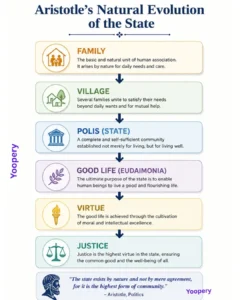
Natural Origin of the State. For Aristotle, the state is not created by agreement or force. It emerges naturally through a sequence of expanding communities, moving from the family to the village and finally to the city-state, or polis.
Good Life. Aristotle insisted that the state exists not merely so that people can live, but so that they can live well. Mere survival is possible outside organised society, but the good life, meaning a life of virtue and fulfilment, is only possible within the political community.
Virtue. Virtue is central to Aristotle’s political thought. He believed that a good state depends on good citizens, and that the purpose of law and education is to cultivate virtuous character in the population.
Ethics and Politics. Aristotle treated ethics as an unfinished project without politics. In the Nicomachean Ethics, he describes politics as the master science, since it directs how all other human activities, including moral development, ought to be organised for the common good.
Purpose of the State. The state exists to secure the good life for its citizens, not merely to keep order or accumulate wealth. A state that fails to promote virtue and happiness, however orderly or prosperous, falls short of its true purpose.
Aristotle’s Theory of the State
Origin of the State. Aristotle traces the origin of the state through three stages. The family forms first, to satisfy daily human needs. Several families combine into a village, to satisfy needs beyond the daily, such as long-term cooperation. Finally, several villages combine into the polis, or city-state, which becomes self-sufficient and capable of the good life.
Family to Village to Polis. Each stage in this sequence grows naturally out of the one before it, so that the state, though it appears last in time, is for Aristotle first in nature and purpose, since the whole is prior to its parts.
State as a Natural Institution. Aristotle firmly rejected the view that the state is an artificial construction resulting from a social contract. He argued that just as a hand separated from the body is no longer truly a hand, an individual separated from the state cannot be truly human. Anyone who could live entirely outside a political community, he wrote, would have to be either a beast or a god.
Purpose of the State. The state exists for the sake of the good life, not merely for life itself. It is simultaneously a government, a school and a moral community, shaping the character of its citizens as much as it manages their affairs.
Organic Theory of the State. Aristotle compares the state to a living organism, in which individuals function like organs. Just as a hand has no life or purpose apart from the body, an individual has no complete existence apart from the political community.
Aristotle’s Theory of Citizenship
Meaning of Citizenship. Aristotle defined a citizen as one who has the right to participate in the administrative and judicial functions of the state, sharing directly in ruling and being ruled in turn.
Qualifications. Citizenship, in Aristotle’s scheme, was not granted merely by residence or birth in a territory. It required active participation in political and judicial office, a privilege reserved for a limited class of free, adult, native-born men.
Good Citizen versus Good Man. Aristotle drew a careful distinction between the good citizen and the good man. A good citizen performs their role well within whatever constitution happens to govern their state, even an imperfect one. A good man possesses virtue in an absolute sense. Aristotle argued that only in the best constitution do the good citizen and the good man coincide completely.
Duties and Rights. Citizenship carried the duty to serve in public office, sit on juries and defend the state, alongside the right to participate in deliberation and judgment.
Exclusion of Women, Slaves and Artisans. Aristotle’s concept of citizenship was strikingly narrow by modern standards. He excluded women, slaves and manual labourers such as artisans and traders from citizenship, believing they lacked the leisure, education or rational capacity he considered necessary for political participation. This exclusion remains one of the most heavily criticised aspects of his political theory.
You must read- Aristotle’s theory of citizenship in detail
Aristotle’s Classification of Government
Aristotle classified governments using two criteria: the number of rulers, and whether they ruled in the common interest or in their own private interest. This produced six types of constitution, three correct and three corrupt.
Correct Forms
- Monarchy, rule by one person for the common good.
- Aristocracy, rule by a few virtuous individuals for the common good.
- Polity, rule by the many for the common good, which Aristotle regarded as the most practically achievable of the correct forms.
Corrupt Forms
- Tyranny, the perversion of monarchy, in which one ruler governs purely for personal benefit.
- Oligarchy, the perversion of aristocracy, in which a wealthy few govern for their own advantage.
- Democracy, the perversion of polity, in which the poor majority governs in its own narrow interest rather than the common good.
| Number of Rulers | Correct Form (Common Good) | Corrupt Form (Self-Interest) |
|---|---|---|
| One | Monarchy | Tyranny |
| Few | Aristocracy | Oligarchy |
| Many | Polity | Democracy |
You must read- Aristotle’s Classification of Government
Aristotle’s Best Practicable State
Mixed Constitution. Aristotle favoured a mixed constitution, or polity, that blended elements of oligarchy and democracy. By combining the wealth-based stability of oligarchy with the broad participation of democracy, a mixed constitution avoided the extremes and instabilities of either pure form.
Rule of Law. Aristotle held that government by law is superior to government by individual rulers, however wise, since law is reason free from passion, while even the best rulers remain vulnerable to emotion and self-interest.
Importance of the Middle Class. Aristotle placed great weight on a strong and numerous middle class as the foundation of political stability. Citizens of moderate wealth, he argued, are the least likely to covet what belongs to others and the least likely to be envied by others, making them the most reliable supporters of constitutional government.
Political Stability. A state dominated entirely by the very rich or the very poor tends towards instability, since one side rules oppressively and the other resents its exclusion. A large middle class moderates this conflict, and this is why Aristotle regarded polity, anchored by a strong middle class, as the best practicable form of government.
Aristotle’s Theory of Justice
Meaning of Justice. Aristotle regarded justice as the complete virtue, and the very essence of political life. Justice provides the state with its aim and the individual with an object worth pursuing, since man, when perfected, is the best of animals, but when separated from law and justice, becomes the worst of all.
General Justice. General justice, for Aristotle, is equivalent to complete virtue exercised in relation to others. A person who observes the laws of the state and treats fellow citizens well demonstrates general justice.
Particular Justice. Particular justice concerns fairness in the distribution of specific benefits and burdens, and it divides into two further types.
Distributive Justice. Distributive justice governs the allocation of honours, offices and rewards among citizens according to merit. Aristotle insisted that equals should be treated equally and unequals unequally, in proportion to their contribution, a principle he called proportionate equality.
Corrective Justice. Corrective justice applies in transactions and disputes between individuals, correcting imbalances caused by wrongdoing. It disregards the personal merit of the parties involved and simply restores equality by taking from the one who has gained unfairly and giving to the one who has been wrongly deprived.
Aristotle’s Theory of Revolution
Meaning. For Aristotle, revolution means any change in the constitution or the ruling group, whether large or small, sudden or gradual. A shift from monarchy to aristocracy counts as a major revolution, while a democracy simply becoming somewhat less democratic still counts as a smaller one.
Causes. Aristotle identified numerous general causes of revolution, including the universal human desire for honour and privilege, resentment against arrogant or exploitative rulers, fear generated by an individual or faction growing disproportionately powerful, and rivalry between different classes, races or families competing for office and influence.
Prevention. Aristotle proposed several practical safeguards against revolution: maintaining strict obedience to law in even small matters, treating excluded groups fairly rather than provoking their resentment, keeping citizens alert to external dangers to preserve unity, limiting how long officials can hold office to prevent the accumulation of excessive power, and above all, adapting education to the spirit of the constitution so that citizens are trained to support the system under which they live.
Importance. Aristotle’s theory of revolution has been called a handbook for statesmen, since it offers one of the earliest systematic analyses of political instability. Later critics note that his view of revolution as merely a political change, rather than a comprehensive social transformation, is narrower than the concept later developed by thinkers such as Karl Marx.
For more detail Read-Aristotle’s Theory of Revolution
Aristotle’s Views on Property
Private Property. Aristotle firmly defended private property against Plato’s proposal of communism for the guardian class. He believed that ownership satisfies a natural human instinct for possession and provides genuine psychological satisfaction that communal ownership cannot replicate.
Criticism of Plato’s Communism. Aristotle’s central criticism was that Plato failed to balance production and distribution properly. Under Plato’s scheme, those who produced nothing, namely the rulers and auxiliaries, received all the comforts of guardian life, while property held in common tends to receive the least care, since everyone assumes someone else will look after it. Aristotle also argued that Plato’s pursuit of excessive unity was misguided, since a state is naturally a plurality of different people, and a state that becomes too unified ceases to be a state at all.
Proper Use of Wealth. Aristotle did not defend unlimited accumulation. He distinguished between property acquired through honest, natural means and wealth acquired through unnatural methods such as usury, which he considered the most objectionable way of making money. His ideal was property that is privately owned but used generously, so that owners voluntarily share its benefits with others, a formula he summarised as private in ownership but common in use.
Aristotle’s Views on Slavery
Natural Slavery. Aristotle argued that some individuals are slaves by nature, lacking the rational capacity to direct their own lives and therefore benefiting from the direction of a master, much as the body benefits from being ruled by the soul.
Justification. He justified slavery as both natural and mutually beneficial, claiming that the master needs a slave to enjoy a life of leisure suited to political and philosophical activity, while the natural slave supposedly benefits from the guidance of a rational master. Aristotle did, however, reject the enslavement of free-born people through conquest as merely conventional rather than natural, and he personally freed his own slaves before his death.
Modern Criticism. This theory is now universally regarded as one of the gravest flaws in Aristotle’s political philosophy. Critics point out that his justification for slavery rests on circular reasoning and reflects the unquestioned social prejudices of his era rather than any coherent principle, undermining his broader claims to scientific objectivity.
Aristotle’s Views on Education
Purpose of Education. For Aristotle, education exists to cultivate virtue and prepare citizens for participation in political life, not merely to transmit knowledge or skills.
Moral Development. He held that intellectual virtues are acquired through teaching, while moral virtues are acquired through habituation, meaning repeated practice of virtuous action from an early age until good conduct becomes second nature.
State-Controlled Education. Aristotle believed education should be a public responsibility rather than a private family matter, since the survival of any constitution depends on citizens being trained in a manner consistent with its particular spirit and values.
Education and Citizenship. Because different constitutions require different civic virtues, Aristotle argued that the content of education must be adapted to the specific type of government in place, so that citizens grow up equipped to sustain and defend that particular political order.
Aristotle’s Views on Family
Marriage. Aristotle regarded marriage as a natural relationship, distinct from mere reproduction, forming one of the essential bonds that hold the household together.
Household. He treated the household, or oikos, as the foundational unit of the state, containing three fundamental relationships: master and slave, husband and wife, and father and child. Household management, which he called economics, was concerned with organising production, distinct from the political sphere of free citizens.
Women. Aristotle regarded women as inferior in their deliberative capacity, though not entirely lacking it, and he believed the husband should rule the wife much as a statesman rules citizens, rather than as a master rules a slave. This view has drawn extensive modern criticism as an unjustified reflection of patriarchal assumptions.
Children. Aristotle held that children lack fully developed rational faculties and should therefore be ruled by their fathers, with education gradually developing their capacity for independent judgment as they matured.
Ethics and Politics
Virtue. For Aristotle, virtue is a settled disposition to act well, cultivated through habituation rather than granted at birth.
Golden Mean. His most celebrated ethical doctrine holds that virtue lies at a mean between two extremes of excess and deficiency. Courage, for example, is the mean between the excess of recklessness and the deficiency of cowardice.
Happiness (Eudaimonia). Aristotle identified the highest human good as eudaimonia, often translated as happiness or flourishing, achieved through a complete life of virtuous activity rather than through pleasure or wealth alone.
Relationship between Ethics and Politics. Aristotle treated ethics and politics as two parts of a single practical science. Individual virtue, he argued, can only be fully realised within a well-ordered political community, and the purpose of the state is precisely to make such virtuous living possible. As he wrote in the Nicomachean Ethics, the object of politics is the attainment of a good and honourable life for the members of the community.
Aristotle vs Plato
| Plato | Aristotle |
|---|---|
| Ideal State | Practical State |
| Idealism | Empiricism |
| Communism | Private Property |
| Philosopher King | Rule of Law |
| Duty-based Justice | Distributive Justice |
Plato began with a general, ideal vision and worked towards specific institutional detail, while Aristotle began with specific observed facts and worked towards general, but revisable, conclusions. Plato regarded the state as a strict unity, almost like a single family. Aristotle regarded the state as a unity in diversity, composed of naturally different individuals whose distinct contributions, taken together, make the community self-sufficient. Where Plato trusted the wisdom of philosopher-rulers above written law, Aristotle trusted the rule of law above the judgment of any single ruler, however wise, since law remains free of the passions that can corrupt even virtuous individuals.
Features of Aristotle’s Political Thought
- Practical, concerned with the best achievable state rather than an unattainable ideal.
- Scientific, grounded in systematic observation and classification.
- Ethical, treating politics as inseparable from questions of virtue and the good life.
- Empirical, built from the comparative study of one hundred and fifty-eight actual constitutions.
- Constitutional, emphasising the rule of law over the rule of individuals.
- Comparative, analysing multiple political systems side by side to identify general patterns.
- Realistic, accepting human nature and political circumstance as they are, rather than as an idealist might wish them to be.
Criticism of Aristotle’s Political Thought
Defence of Slavery. Aristotle’s theory of natural slavery remains the most serious blemish on his political philosophy, resting on assumptions about human inequality that modern thought rejects entirely.
Limited Citizenship. His narrow definition of citizenship excluded the vast majority of the population, including all women, slaves and manual workers, from any political voice.
Position of Women. His view that women possess a permanently inferior deliberative capacity reflects the unexamined prejudice of his time rather than careful empirical observation, an inconsistency notable in a thinker who otherwise prized evidence over assumption.
Greek City-State Bias. Aristotle’s entire framework assumes the small, self-sufficient city-state as the natural and ideal scale of political life, a model that became obsolete as large empires and, eventually, nation-states replaced the Greek polis.
Elitist Elements. Despite his practical orientation, Aristotle’s political thought retains an elitist strain, confining full political participation to a leisured class of free-born men and denying that ordinary labourers could achieve genuine civic virtue.
Modern Criticism. Contemporary scholars value Aristotle’s empirical method while firmly rejecting the social prejudices, concerning slavery, gender and class, that shaped his particular conclusions, treating his framework as separable from these outdated applications.
Contribution and Legacy
Father of Political Science. Aristotle earned this title through his systematic, evidence-based approach to studying government, treating politics as an empirical discipline rather than a purely philosophical exercise.
Contribution to Political Theory. His classification of constitutions became the standard reference point for later thinkers, and his emphasis on the rule of law, the value of a stable middle class, and the causes of political instability remain foundational concepts in political science.
Influence on Roman Thinkers. Roman statesmen and philosophers, including Cicero, drew on Aristotelian ideas of natural law and mixed constitutions in shaping Roman political thought.
Influence on Medieval Political Thought. Following the translation of his works into Arabic and later Latin, Aristotle became central to medieval scholasticism. Thomas Aquinas, in particular, integrated Aristotelian political and ethical theory into Christian philosophy, and Aristotle came to be known simply as The Philosopher throughout the medieval period.
Influence on Modern Constitutionalism. Aristotle’s insistence on the rule of law over the rule of individuals anticipates core principles of modern constitutional government, and his theory of mixed government influenced later thinkers, including those who designed systems of checks and balances.
Relevance Today. Aristotle’s emphasis on the middle class as a stabilising force, his warnings about the causes of political instability, and his insistence that good government requires the cultivation of civic virtue continue to inform debates in comparative politics and democratic theory.
Famous Quotes of Aristotle
- “Man is by nature a political animal.” Politics. This foundational claim asserts that humans can only fully realise their nature within an organised political community.
- “He who is unable to live in society, or who has no need because he is sufficient for himself, must be either a beast or a god.” Politics. Aristotle uses this striking image to argue that ordinary human beings require political community to live complete lives.
- “The law is reason free from passion.” Politics. This captures Aristotle’s preference for the rule of law over rule by individuals, however capable, since law alone is untouched by emotion or self-interest.
- “But a state exists for the sake of a good life, and not for the sake of life only.” Politics. This distinguishes Aristotle’s view of the state’s purpose from mere survival or economic organisation.
- “For where the laws do not rule there is no regime.” Politics. Aristotle treats respect for law as the very definition of a legitimate political order.
- “It is not possible to rule well without having been ruled.” Politics. This reflects his belief that citizens should share in ruling and being ruled in turn, gaining practical political wisdom through both experiences.
- “It is not the possessions but the desires of mankind which require to be equalized.” Politics. Part of his critique of communistic schemes, arguing that unchecked desire, not property itself, is the true source of social conflict.
- “When several villages are united in a single complete community, large enough to be nearly or quite self-sufficing, the state comes into existence.” Politics. This summarises his account of the natural, gradual origin of the polis.
- “We regard the object of politics as supreme, which is the attainment of a good and honourable life of the members of the community.” Nicomachean Ethics. This links his ethical and political theories, treating politics as the science that organises the conditions for virtuous living.
- “The good in the sphere of politics is justice, and justice contains what tends to promote the common interest.” Nicomachean Ethics. This defines justice as the central virtue of political life, oriented always towards the common good rather than private advantage.
Frequently Asked Questions (FAQ)
Biography
- Who was Aristotle? A Greek philosopher born in 384 BC in Stagira, student of Plato, tutor of Alexander the Great, and founder of the Lyceum.
- Why is Aristotle famous? For founding systematic logic, biology, and political science, and for his enormous influence on nearly every subsequent field of Western thought.
- What is Aristotle’s most famous work? The Politics, though the Nicomachean Ethics is equally central to his legacy.
- What was Aristotle’s greatest achievement? Establishing the empirical, comparative study of politics as a distinct scientific discipline.
- Who taught Aristotle? Plato, at the Academy in Athens.
- Who was Aristotle’s most famous student? Alexander the Great.
Political Thought
- Why is Aristotle called the Father of Political Science? Because he was the first to study government systematically and empirically, comparing one hundred and fifty-eight actual constitutions rather than reasoning from an ideal alone.
- Why did Aristotle call man a political animal? Because he believed humans, through their unique capacity for speech and moral reasoning, can only achieve their full nature and the good life within an organised political community.
- What is Aristotle’s theory of the state? That the state arises naturally through the sequence of family, village and polis, existing not merely for life but for the good life.
- What is Aristotle’s theory of citizenship? That a citizen is one who actively shares in ruling and being ruled, a status Aristotle limited to free, native-born men, excluding women, slaves and manual labourers.
- What is Aristotle’s classification of government? Six forms, based on the number of rulers (one, few or many) and whether they govern for the common good (monarchy, aristocracy, polity) or for private interest (tyranny, oligarchy, democracy).
- What is Aristotle’s best form of government? Polity, a mixed constitution anchored by a strong middle class, though he considered ideal kingship theoretically superior if a sufficiently virtuous ruler existed.
- What is Aristotle’s theory of justice? That justice is complete virtue in relation to others, divided into general justice and particular justice, the latter further split into distributive justice (proportionate allocation) and corrective justice (restoring fairness after wrongdoing).
- What is Aristotle’s theory of revolution? That revolution is any change in the constitution, caused chiefly by inequality, resentment and the ambition of individuals or factions, and best prevented through the rule of law, fair treatment of all groups, and constitution-appropriate education.
- What is Aristotle’s view on private property? That property should be privately owned, since ownership satisfies a natural human instinct, but generously shared in its use for the benefit of the wider community.
- What is Aristotle’s view on slavery? That some individuals are slaves by nature, a theory now universally rejected as reflecting the unexamined prejudice of his era rather than sound reasoning.
- How is Aristotle different from Plato? Aristotle favoured empirical observation over deduction, private property over communism, the rule of law over rule by philosopher-kings, and a practicable state over an unattainable ideal.
Philosophy
- What is the main concept of Aristotle? That all things, including human beings and states, have a natural purpose, or telos, towards which they develop and by which they should be judged.
- What are the three main ideas of Aristotle? The doctrine of the golden mean, the natural origin and purpose of the state, and the classification of constitutions into correct and corrupt forms.
- What does Aristotle teach us? That good government and a good life both depend on the deliberate cultivation of virtue, guided by reason and tested against the realities of human experience.
- What are Aristotle’s major contributions to philosophy? The founding of formal logic, the systematic classification of the sciences, the doctrine of the four causes, virtue ethics centred on the golden mean, and the empirical study of politics and biology.
Conclusion
Aristotle’s political thought marks a decisive turn from the idealism of his teacher Plato towards a practical, evidence-based science of government. By grounding his theory in the study of real constitutions rather than an unattainable ideal, he gave the world its first systematic classification of governments, its earliest sustained analysis of political instability, and an enduring case for the rule of law over the rule of individuals. His insistence that man is a political animal, that the state exists for the sake of the good life, and that a stable middle class anchors good government, continues to shape political science today. At the same time, his defence of natural slavery and his exclusion of women and labourers from citizenship stand as serious and rightly criticised limitations, reminders that even history’s most systematic thinkers remain products of their own time. Taken as a whole, Aristotle’s legacy endures not because every conclusion he reached was correct, but because the questions he asked, about justice, stability, citizenship and the good life, remain exactly the questions political science continues to ask today.